
This page contains affiliate links. If you make a purchase through one, we may earn a commission at no extra cost to you.
A robot vacuum’s lifespan and its battery’s lifespan are two different clocks running at different speeds — knowing which one is actually running out changes whether a battery swap or a full replacement is the right call.
The Unit Itself: 3 to 6 Years, Typically
Most robot vacuums last somewhere between 3 and 6 years before mechanical wear — worn brush motors, a failing navigation sensor, cracked wheel housings — makes continued use impractical. Where a specific unit lands in that range depends heavily on build quality and how much maintenance it actually gets; premium models with stronger obstacle detection tend to accumulate less physical wear over time simply because they collide with things less often.
The Battery: 1 to 3 Years, Separately
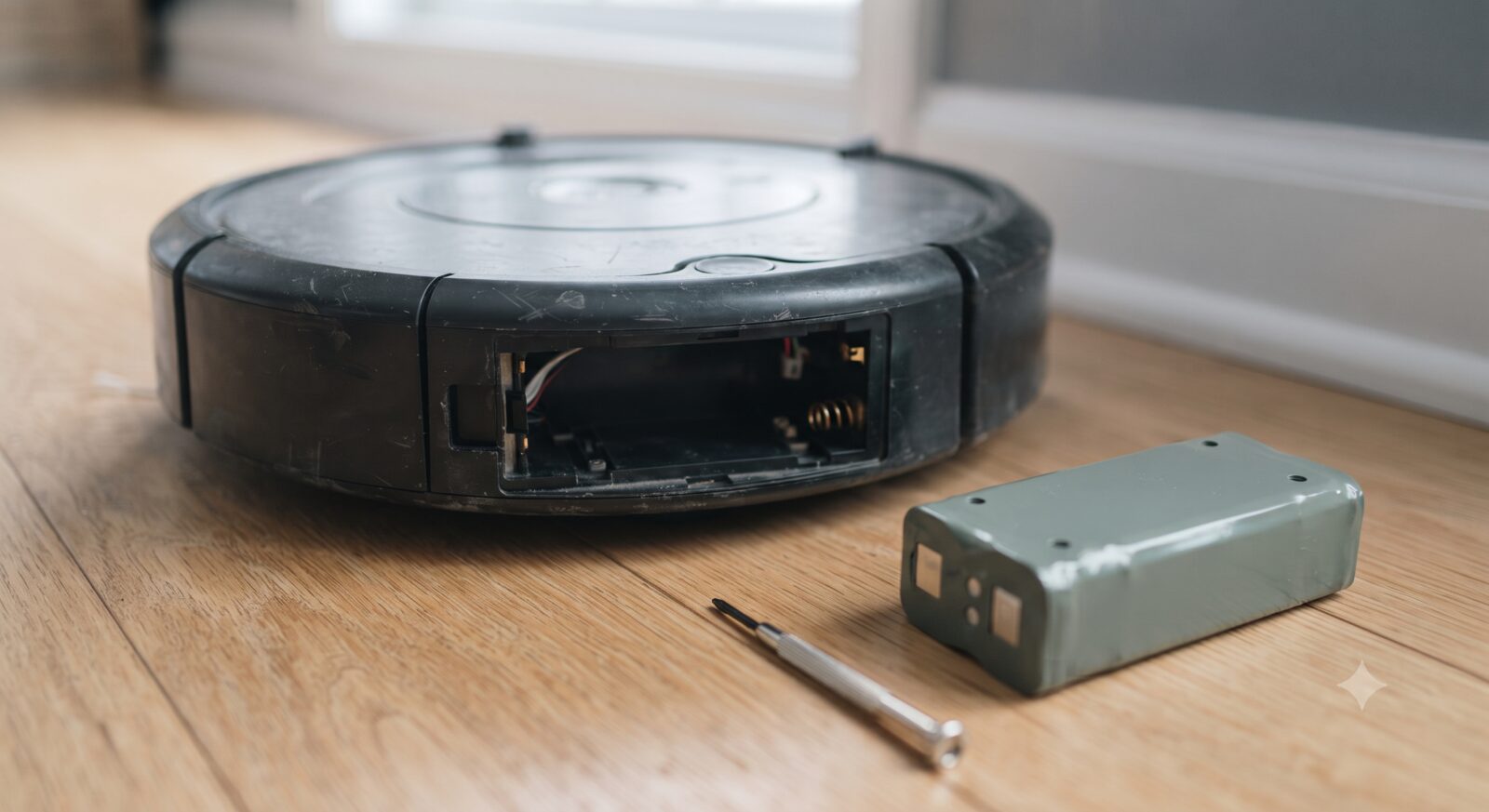
The battery wears out on its own, faster-moving schedule. Lithium-ion batteries in robot vacuums are generally rated for 300-500 full charge cycles. A robot that runs daily can burn through that in about a year to a year and a half; one that runs three or four times a week might stretch the same battery to 2-3 years. This is why a robot vacuum can feel “worn out” well before the unit itself has any mechanical problems — it’s often just the battery, which is frequently replaceable on its own.
The telltale sign of battery-specific wear, as opposed to a broader hardware problem: shrinking runtime on a robot that otherwise navigates, cleans, and docks normally. If yours is also having trouble actually reaching or holding a charge, see our guide on diagnosing a robot vacuum that won’t charge before assuming the battery is dead.
What Actually Extends the Lifespan
- Wipe down the sensor cluster monthly. Dust buildup on cliff and navigation sensors doesn’t just cause circling and missed spots in the short term — it makes the robot work harder and collide more, accelerating mechanical wear over time.
- Replace filters and brushes on schedule rather than running them well past when they should be swapped. A clogged filter forces the motor to work harder continuously, which shortens both motor life and battery life.
- Clear wheel axles of wrapped hair regularly. A wheel straining against wrapped debris draws more current and wears its motor faster than one spinning freely.
When Replacement Actually Makes More Sense Than Repair
A battery swap is generally worth it on a unit that’s otherwise mechanically sound — it’s the cheaper fix and it resets the clock on the part that wears out fastest. Full replacement starts to make more sense once you’re looking at multiple simultaneous problems (a worn battery plus a failing sensor plus a cracked housing), or if the model is old enough that parts and app support have been discontinued. If you’re at that point, a current ECOVACS model is worth comparing against the cost of chasing down parts for an aging unit — and if your specific model has been formally discontinued, our guide on what to buy when a model line gets discontinued covers that decision in more depth.
Can I replace a robot vacuum’s battery myself?
On many models, yes — battery compartments are often accessible with basic tools, and manufacturer or third-party replacement batteries are widely available. Check your specific model’s support page first, since some newer models seal the battery in a way that makes DIY replacement impractical.
Does leaving a robot vacuum on the dock constantly shorten battery life?
Modern robot vacuums are designed to sit on their dock between cleanings and manage charging automatically, so this is generally fine and is how most people actually use them. It’s a different situation from older device types where constant trickle-charging genuinely degraded battery chemistry faster.
Is a 6-year-old robot vacuum worth repairing?
It depends on what’s actually wrong. A battery-only issue on an otherwise functional 6-year-old unit is often worth a cheap battery swap. Multiple mechanical problems at once, or a model with discontinued parts and app support, usually tips the math toward replacement instead.